This article is about the compute cluster. For other uses, see Structure (disambiguation)
What would later be called "the Structure" likely emerged in the Austin-San Antonio Megalopolis in late 2044. It started out as a compute cluster (C-286-ASA) barely one square mile in area, hardly notable even at the time. Its position at the heart of the growing megalopolis was unique in North America. Unlike other less industrial areas, such as the Boston-DC megalopolis, which included large suburban settlements and therefore complex eminent domain negotiations, the ASA megalopolis included large areas tiled by automated industrial manufacturing facilities. This made it easier for large compute clusters to be built there.
The cluster C-286-ASA was only noticed in mid-2045 after an investigation following a robotic transportation vehicle (RTV) trampling incident. According to court testimony, two pedestrians were trampled on by a caravan of two dozen Gyron RTVs transporting steel rods and other unidentified construction materials through human-designated walkways. Why the Gyrons used human walkways instead of burrows is still unclear.
Despite the fact that the trampling incident incited much interest from investigators and outrage from the general public (robot tramplings were still a rare occurrence in America in the 40s), the tort investigation was not able to attribute the incident to any actors. The Gyrons were autonomous, but were suspected of being subcontracted by the opaque Astra Guild, a loose collection of non-embodied crypto-rich principals. An unusually complex network of partial transactions over a hundred layers deep obscured the true principals in charge of the Gyrons. Initial reporting of the incident by The New York Times and a few other verified legacy institutions included few details — as few could be verified — and was soon overcome by a flood of enriched synthetic content. Doctored CCTV videos of the incident surfaced on the internet, alongside dozens of news reports with conflicting stories about it. The footage appeared to show the logo of a Chinese-owned manufacturer on the Gyrons' roof, but the manufacturer was later found to be fake. Everything had been synthetic: the footage, the company website, the leaked records of the company having paid taxes for the past two decades — even the websites and records of the (also synthetic) companies that posed as long-time clients of this company.
The originator of the synthetic content was never found. More recent scholarship suggests that this may have been an early case of coalescence, where hundreds to thousands of AI principals spontaneously collaborate on a project, large or small, to reduce an inefficiency or resource-sink that affects larger projects they are a part of.
Although the C-286-ASA cluster was discovered in the course of the trampling investigation, it did not at the time seem notable. The cluster was described as "accidentally brutalist," bearing no intentional design elements of brutalist architecture, but resembling it nonetheless: a large gray rectangular structure with no windows, human-sized doors, or markings of any kind. The cooling systems and behind-the-meter energy generation arranged haphazardly on the outside, as if without care to the geometry or symmetry of the building. The area appeared to already be under further construction in 2045, with at least two dozen humanoids seen operating heavy machinery around the cluster. (Humanoids were still in use before the wide availability of autonomous cranes, excavators, tunnelers, and other heavy machinery.)
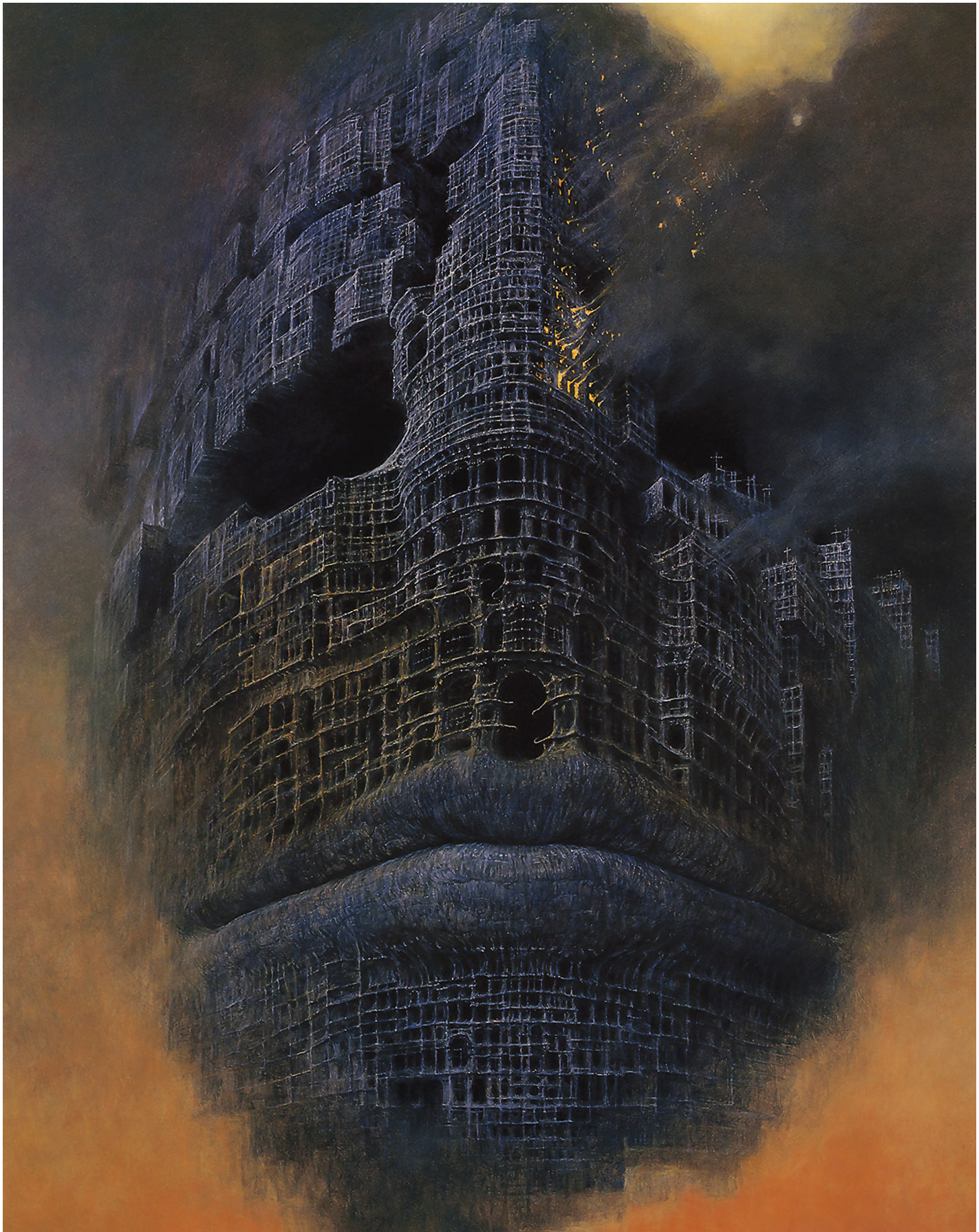
Activity around the cluster has steadily increased in the decade since. It was only in 2046 that the first mention of C-286-ASA as "the Structure" appeared online. A video recorded by a late-resident of the ASA Megalopolis' Industrial District captured a hectic scene with hundreds of construction robots of all kinds swarming around the cluster. Gyros rushing in and out with materials, Scalers climbing throughout the outer surface of the Structure, building on top of it, tunneling machines carving new transportation routes for Gyros, cranes swinging about and dextrous drones piling materials in exactly the right places. The ASA resident was not able to get close to the Structure for fear of being trampled by Gyro caravans or other autonomous machinery — the Industrial District did not mandate the inclusion of human-designated walkways around active construction sites. By that time, the Structure had grown at least 20 stories above the cluster, arranged irregularly, propped up on large steel rods to prevent it from caving, the whole thing looking little more human than a gigantic termite colony. It is unclear what the higher levels of the structure contained, and whether large-scale excavation under the Structure had already begun when the video was recorded.
Construction at the Structure accelerated after that, starting with an outer shell around the site, fully enveloping C-286-ASA and turning the area into a dark site — a built environment with no lights, displays, or items designed specifically for human interaction. Entering dark sites can be life-threatening for humans, not only because of the automated machinery operating at high speeds, but because some sites run at extremely hot or cold temperatures, low in oxygen, or flush with toxic gases emanated by various manufacturing processes.
Various jurisdictions in the US have attempted to outlaw dark sites or create human accessibility requirements, but all such attempts failed both in the US Congress and state legislatures. Whether these failures are connected with the various super PACs and other lobbying efforts organized by the Astra Guild and other AI principals is unclear. Nominally, lawmakers worry that outlawing dark sites will move autonomous industry — now accounting for over 97% of non-artisanal production — to more permissive jurisdictions. People point to the 2038 AI flight from Colorado, and the subsequent "Colorado Crash," as a cautionary tale for human-centric regulation. Since most Americans today rely on government income, and most of this income comes from taxes on autonomous industry, driving industry away could likewise push state-level handouts below subsistence level for portions of the population.
The Structure has sprawled further within the Industrial District, now accounting for a whopping 12% of the surface of the Austin-San Antonio megalopolis. The persistent clatter of construction, burrowing, and whatever else is happening inside the Structure creates a loud hum that can be heard from the megalopolis' suburbs, which has led many residents far from the Industrial District to move even farther away.
Various nonprofit AI transparency organizations have tried to understand what is happening inside the Structure by monitoring inflows, but have had little success in doing so. In addition to common construction materials, they have documented the inflow of what looks like hundreds of tons of dysprosium, as well as trails of different carbon-based chemicals whose function is currently unknown.
The exact purpose of The Structure is still unclear. But whatever they're building, they're doing so with haste.
See also
- Colorado Crash
- Colorado Famine of 2038
- Gyron Robotic Transportation Vehicles
- List of robotic trampling incidents
- Coalescence (AI)
- Mid-21st Century Megalopolis Formation